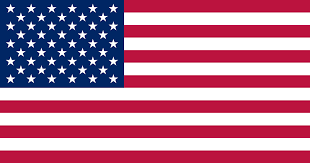
The flag, at its core, is a powerful symbol. It’s more than just a piece of cloth; it’s a visual representation of identity, history, and belonging. Early flags served to identify specific armies or noble houses on the battlefield. Flags serve as crucial political symbols, signifying territorial claims and national sovereignty. They are potent markers of identity, fostering national unity and pride by representing shared history and aspirations. Beyond national contexts, flags also appear in subnational divisions and various social and cultural spheres, from sports to personal expression.
Some examples of symbols in flags of the world, the red and white stripes on the US flag represent the 13 original colonies, and the 50 stars represent the fifty states of the United States. (Figure 1).
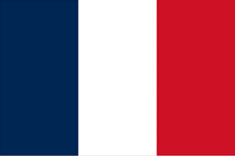
Some flags reflect symbolism like the French flag; its colors (blue, white, and red) symbolize liberty, equality, and fraternity respectively. (Figure 2).
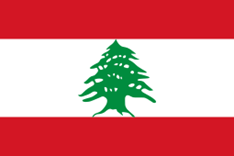
Another foundation to establish, create, or design a flag is geographical features. One example for flags that are designed based on geographical features is the flag of Lebanon. The cedar tree is a prominent symbol of the country since cedar trees are widely spread in Lebanon. (Figure 3).
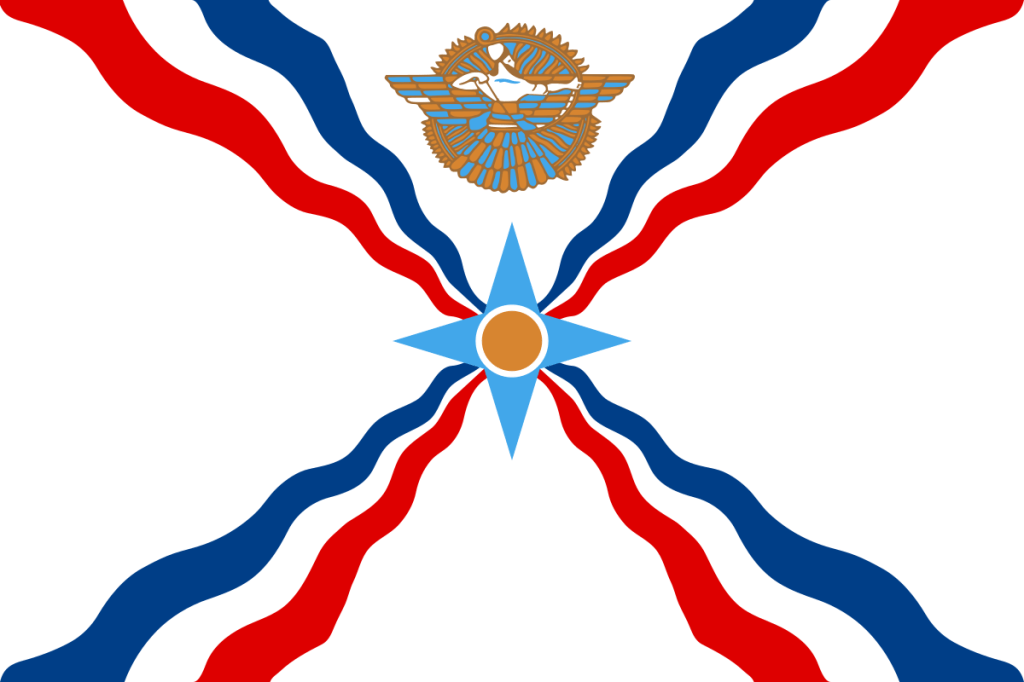
And regarding the Assyrian flag, and based on a brochure by The Assyrian Universal Alliance:

“The Assyrian flag is designed with a white background on which three waving stripes emerge from each corner of a center design which is in the shape of a four headed star. At its center, the star encompasses a golden center representing Shamash, the Assyrian god of the sun…. The four wedges of the star are a bright blue color and represents happiness and tranquility.
“[The stripes] symbolize the three major rivers flowing the land of Assyria. At the top we see the mighty Euphrates, represented in blue denoting abundance. In the center the great Zab is in white portraying peace, and in the bottom we see the mighty Tigris in a red color representing the Assyrian national pride. [They] also [picture] the rays of the center star and stand to symbolize the dispersion of the Assyrian people to the four corners of the world.
“Hovering over the star and the emblem of Shamash, there is a representation of the image of God Ashur the ancient Assyrian supreme deity. Ashur has drawn a bow and his arrow is ready to fly.”
Now that we’ve explored the symbolism of the Assyrian flag, I’d like to share some personal observations from my experiences participating in the Kha B’Nissan festivities in Nuhadra (Duhok). During the vibrant Khigga celebrations, I’ve witnessed instances where individuals would enthusiastically grasp the Assyrian flag and dance while waving it vigorously. This passionate display, although out of love, often led to the flag twisting and turning around its pole or stick, sometimes even becoming entangled. Furthermore, I’ve observed instances where the largest flag size was inadvertently dragged along the ground, which, while unintentional, is considered improper flag etiquette. I want to add that making handkerchiefs out of flags, or drawing a flag on the bride and groom’s dancing handkerchiefs (yalikhyateh), is also considered improper flag etiquette. I myself may, or may not, have been guilty of some of these actions at one point of my life.
Based on some rules of respecting the flag that I found on a US Citizenship booklet, dancing with the flag is a sign of disrespect towards the flag, and hence, to the nation, to the land, to the symbols of the flag like the god Ashur. Here are some rules:
- No disrespect should be shown to the flag of the United States of America; the flag should not be dipped to any person or thing. Regimental colors, State flags, and organization or institutional flags are to be dipped as a mark of honor.
- The flag should never be displayed with the union down [should never be displayed upside-down], except as a signal of dire distress in instances of extreme danger to life or property. [The inversion of the colors of the stripes (red on top) is wrong, and suggests that our nation is in “dire distress” and we are not weak to be in such situation].
- The flag should never touch anything beneath it, such as the ground, the floor, water, or merchandise.
- The flag should never be carried flat or horizontally, but always aloft and free.
- The flag should never be used as wearing apparel, bedding, or drapery. It should never be festooned, drawn back, nor up, in folds, but always allowed to fall free. Bunting of blue, white, and red, always arranged with the blue above, the white in the middle, and the red below, and should not be used for covering a speaker’s desk, draping the front of the platform, and for decoration in general.
- The flag should never be fastened, displayed, used, or stored in such a manner as to permit it to be easily torn, soiled, or damaged in any way.
- The flag should never be used as a covering for a ceiling.
- The flag should never have placed upon it, nor on any part of it, nor attached to it any mark, insignia, letter, word, figure, design, picture, or drawing of any nature.
- The flag should never be used as a receptacle for receiving, holding, carrying, or delivering anything.
- The flag should never be used for advertising purposes in any manner whatsoever. It should not be embroidered on such articles as cushions or handkerchiefs and the like, printed or otherwise impressed on paper napkins or boxes or anything that is designed for temporary use and discard. Advertising signs should not be fastened to a staff or halyard from which the flag is flown.
- No part of the flag should ever be used as a costume or athletic uniform. However, a flag patch may be affixed to the uniform of military personnel, firemen, policemen, and members of patriotic organizations. The flag represents a living country and is itself considered a living thing. Therefore, the lapel flag pin being a replica, should be worn on the left lapel near the heart.
- The flag, when it is in such condition that it is no longer a fitting emblem for display, should be destroyed in a dignified way, preferably by burning.
We can see similarities in a few rules of the etiquettes of the Iraqi flag that I translated into English:
- It is prohibited to use the national flag for decoration.
- It is prohibited to use the national flag for clothing.
- When the flag is at half-mast, only with a formal order, it must be raised to the top of the pole, saluted, and then lowered to only the width of the flag itself, except the flags of Iraq and Saudia Arabia for containing the name of God.
- The national flag must not be placed on a podium or a table for covering.
- No other flag of any country or organization must be raised higher than the national flag.
The flag, as a multifaceted symbol, encapsulates a nation’s history, values, and aspirations, acting as a powerful visual representation of identity and belonging for both individuals and the collective. Respecting its symbolism and proper etiquette is crucial for upholding the dignity of these powerful emblems. Specifically, the Assyrian flag, carrying an emblem of a deity once sacred to our ancestors, demands reverence, particularly during the Assyrian New Year/Akitu. Therefore, let us honor its significance and refrain from disrespectful uses; this also includes handkerchiefs and dancing canes in Assyrian weddings.
 Shibla BetShmuel